

BERLIN
DESIGN AWARD
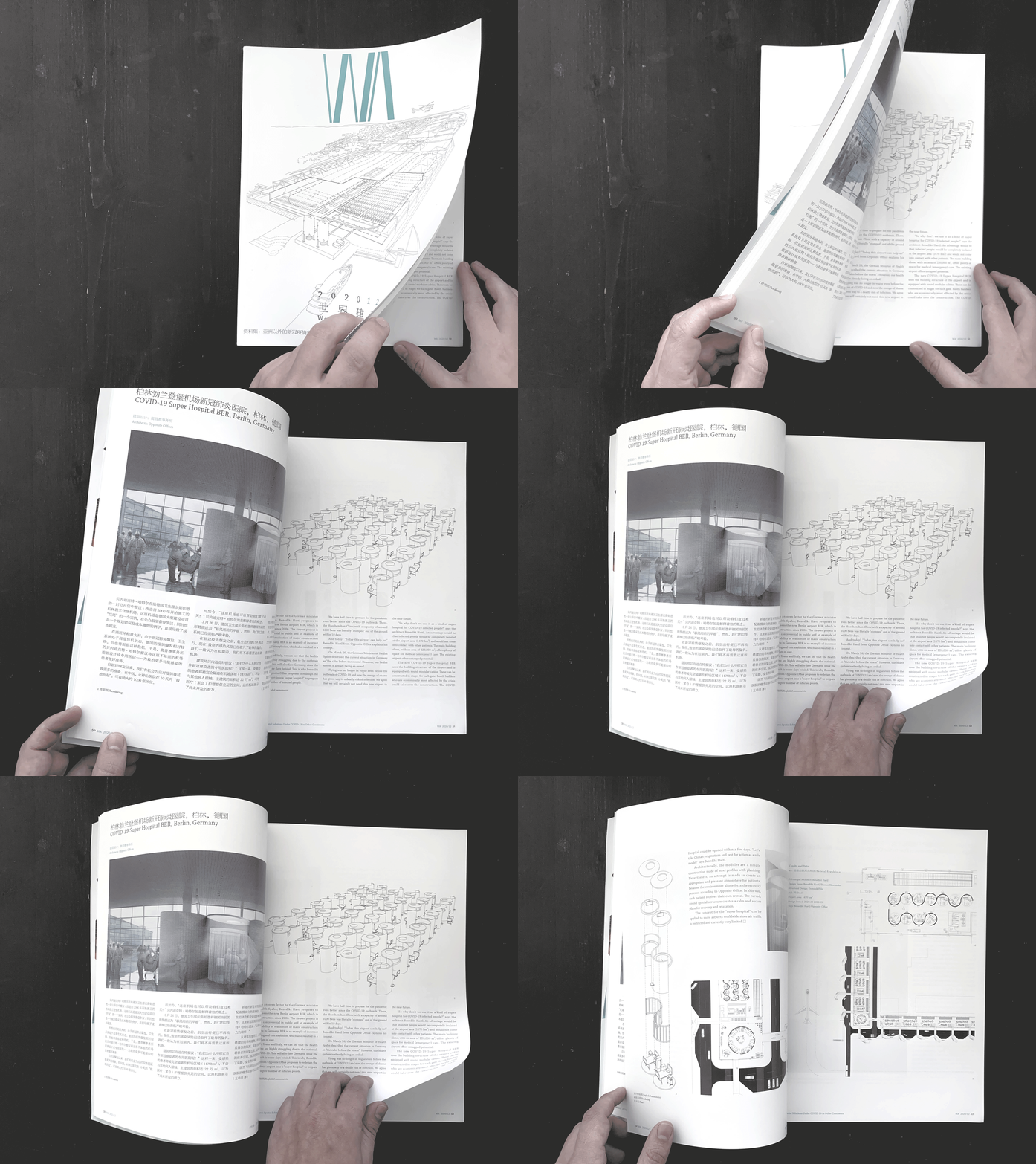

COVID-19 SUPERHOSPITAL-BER
Project: Covid-19 Superhospital BER Year: 2020 Type: open proposal, not built Program: hospital isolationstation Area: 1470ha Architecture: Opposite Office Team: Benedikt Hartl
Place: Berlin, GER Client: Flughafen Berlin Brandenburg GmbH
Opposite Office was not invited to the 1998 competition for the Berlin Brandenburg Airport—at the time, the studio had yet to be founded. The competition was awarded to gmp, and construction commenced in 2006. However, due to extensive delays and planning failures, the airport remained unopened for more than a decade.
In early 2020, amidst the global COVID-19 pandemic and with international air traffic at a historic low, Opposite Office proposed a radical retrospective intervention: transforming the still-unused airport into a superhospital.
The concept was driven by pragmatism and urgency. The terminal building offered 220,000 square meters of ready-built space, while the entire site spanned 1,470 hectares. Crucially, technical infrastructure—including ventilation, electricity, water supply, and digital networks—was already in place. The location, isolated yet fully connected to transportation networks, provided an ideal foundation for a rapid and large-scale medical facility. Rather than constructing a new hospital from scratch, the proposal focused on adaptive reuse of an existing, underutilized asset.
The design introduced prefabricated modular units within the terminal’s gate areas: curved steel cabins, each accommodating a single patient in isolation with space for rest and care. This system could be implemented in phases, scaled as necessary, and installed quickly. Local construction companies, many impacted by the economic shutdown, could be enlisted for fabrication and assembly.
Runways were reimagined as logistical corridors, while the spatial layout allowed for strict separation between patients, staff, and supply zones—crucial for infection control. The airport’s scale, infrastructure, and spatial qualities made it uniquely suited to emergency healthcare deployment.
Submitted to the German Ministry of Health without commission, the proposal garnered considerable international attention—particularly in China, where its clarity and pragmatic approach were widely recognized. Since then, Opposite Office has emerged as a reference point in healthcare design and is now regularly invited to participate in international competitions for medical infrastructure.
project description in English:
in English:
in German:
md Interior Design Architecture
in Spanish:
VD El Mercurio N 1.242
in Polish
in Bulgarian
in Arabic
Albenaa Magazine Volumen 41, S. 20-25
in Chinese
世界最受欢迎的建筑网站
World Architecture Magazine