



HOLY SHIT
Projekt: AFAM Roadshow at IED Roma Jahr: 2025, Typ: Ausstellung Konzept: Opposite Office Team: Studierende der IED Roma Kurator Luca Longobardi Ort: Roma
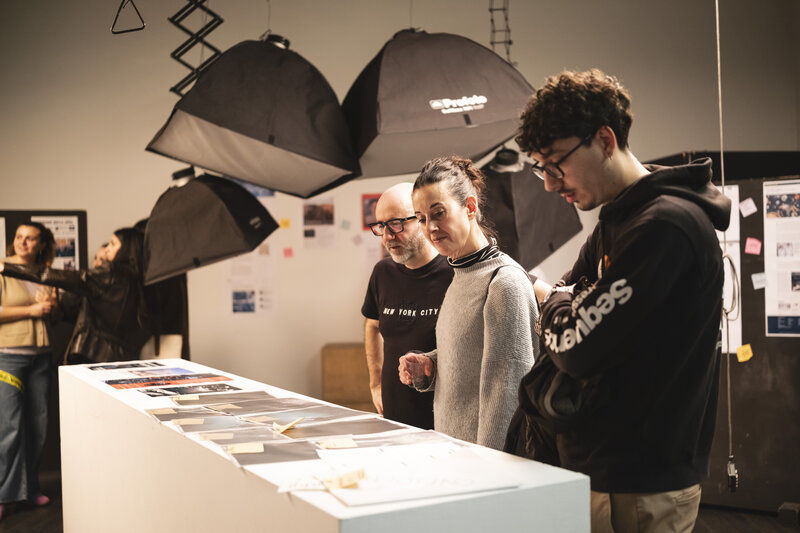
During IED Factory 2025, 200 students worked with 9 international artists and professionals to explore the role Artificial Intelligence plays in the artistic and creative process.
From the exploration of digital loneliness to the creation of a virtual pop star, the reinterpretation of sacred rituals, and the production of deepfakes, the workshops of IED Factory 2025 challenged the boundaries and potential of technology. The event, which culminated on February 28 with a public exhibition, revealed the tensions between the human and the artificial, the need for a new visual and auditory language, and the role of AI as both a critical tool and an instrument of experimentation. IED Factory 2025 demonstrated that Generation Z is not passive in the face of emerging technologies but seeks to master their language, transforming their imperfections into new aesthetics and their predictive capabilities into creative material. The artistic direction of this edition was entrusted to Luca Longobardi, composer, multimedia artist, and IED Rome lecturer.
AI and Digital Loneliness: Bodies, Identities, and New Forms of Connection
The relationship between AI and digital loneliness was one of the central themes of the event. Several workshops investigated how AI is redefining self-perception and emotions, exploring the sense of alienation linked to virtual worlds. In the workshop In your absence, the Field A1 collective examined the concept of synthetic identity through an interactive installation in which digital avatars replicated human emotions, exposing the contrast between our public self and our inner reality. The most intense moment of the installation took place in a room where a virtual MetaHuman interacted with the audience: when observed, it smiled; when ignored, it cried. A powerful image of the duality between online visibility and hidden vulnerability.
The project engaged in dialogue with Poetics of the Body, a performance curated by Ginevra Napoleoni, which depicted the paradox of hyper-technological connection and emotional isolation. Starting from the body—perceived as an isolated bubble in space—the performance illustrated a rhythmic, alienating sentiment, turning into a looped chorus. The encounter with a reactive avatar marked the transition from individual solitude to technological connection, transforming isolation into a new inner movement.
Deepfake, Synthetic Worlds, and New Narratives
Young creatives also explored how AI is not just a tool for generating images but also for distorting them. In the workshop Synthetic Overflow, Canio Salandra worked with students on AI’s power to generate artificial narratives, creating a series of deepfake images. The goal was to examine the thin line between reality and fiction, turning fragments of imagination into realistic photos of events and scenes. Each piece challenged our trust in images and their role in shaping collective memory.
In an era of misinformation and visual simulation, the project raised questions about the production and dissemination of AI-generated content, encouraging a critical perspective on how we perceive reality.
Music, Glitches, and Errors: When AI Generates New Sonic Aesthetics
During IED Factory 2025, AI was also used to redefine the language of sound. The group of students led by Benedetto Battipede created Zaya, a virtual singer entirely developed with AI, whose backstory, musical style, and marketing strategy were all carefully designed. Her debut song, Maschere sull'Acqua, is a direct critique of "hit-and-run" tourism and the transformation of entire cities into mere backdrops for distracted crowds.
In the workshop [IM]PERFECT.AI, Federico Coderoni challenged the concept of digital perfection, transforming glitches and errors into creative possibilities.
AI and Contemporary Rituals: Reinterpreting the Sacred Through Technology
AI was also employed to redefine the meaning of collective symbols. Benedikt Hartl, along with his students, artistically reinterpreted the significance of the Jubilee in a contemporary context. Participants developed an artistic stance reflecting on the spiritual, cultural, and social dimensions of the Holy Year.
Using Artificial Intelligence tools and crafting a narrative suspended between reality and fiction, each group proposed a personal interpretation of the Jubilee, questioning its role in today's world.
link:
https://www.artribune.com/mostre-evento-arte/ied-factory-2025-ai-e-plurals/
https://grandtourafam.it/en/event/a-i-and-plurals-the-open-generation/